Home / Ingredients
What is in a lash serum, and what it does
Three ingredient families cover almost everything sold in the UK. They differ in how fast they work, how much they cost and what they can do to the skin around your eye. This page is the reasoning behind the safety column in our ranking.
Family 01
Peptides
Myristoyl pentapeptide-17, biotinoyl tripeptide-1 and similar chains. They support the follicle while the lash is in its growth phase, which means they cannot do anything to a lash that has already stopped growing.
Expect: visible change at week five to eight, no irritation in most people, results that hold as long as you keep using it.
Family 02
Conditioners
Panthenol, biotin, hyaluronic acid, castor and ricinus oils. They coat and soften the lash so fewer break off at the tip — the lash line looks fuller without a single new millimetre being grown.
Expect: better condition within a fortnight, no measurable length, and a very low chance of a reaction.
Family 03
Prostaglandin analogues
Isopropyl cloprostenate, dechloro dihydroxy difluoro ethylcloprostenolamide, methylamido dihydro noralfaprostal. Chemical relatives of glaucoma eye drops, whose lash-lengthening effect was discovered as a side effect.
Expect: the fastest and largest change, and the only documented risk of lasting cosmetic side effects.
The one thing worth knowing
Why prostaglandin analogues are capped in our scoring
These ingredients work. That is not in dispute — the strongest measured result in our own panel came from a formula that contains one. The question is what else they do while they are working, and the answers are well documented in ophthalmology, because the same molecules have been prescribed for glaucoma for decades.
Documented effects
- Iris darkening. Blue, green and hazel eyes can turn permanently browner. This does not reverse when you stop.
- Periorbital skin darkening. A grey-brown shadow along the lid, which usually fades over several months after stopping.
- Fat pad atrophy. A hollowing of the upper lid that makes the eye look sunken. Slow to appear, slow to recover.
- Redness and dryness. The common, mild, reversible end of the range — and the reason two of our testers stopped early.
They are legal to sell as cosmetics in the UK, and they are not a reason to panic if you have used one. They are a reason to make the choice knowingly, which is why every product in our ranking that contains one is labelled on the card, in the table, and again in the review text.
Who should avoid them entirely
Anyone with light-coloured eyes who would mind the change, anyone being treated for glaucoma or ocular hypertension, anyone with a history of eye surgery or macular oedema, and anyone pregnant or breastfeeding. In every one of those cases, a peptide serum is the sensible route.
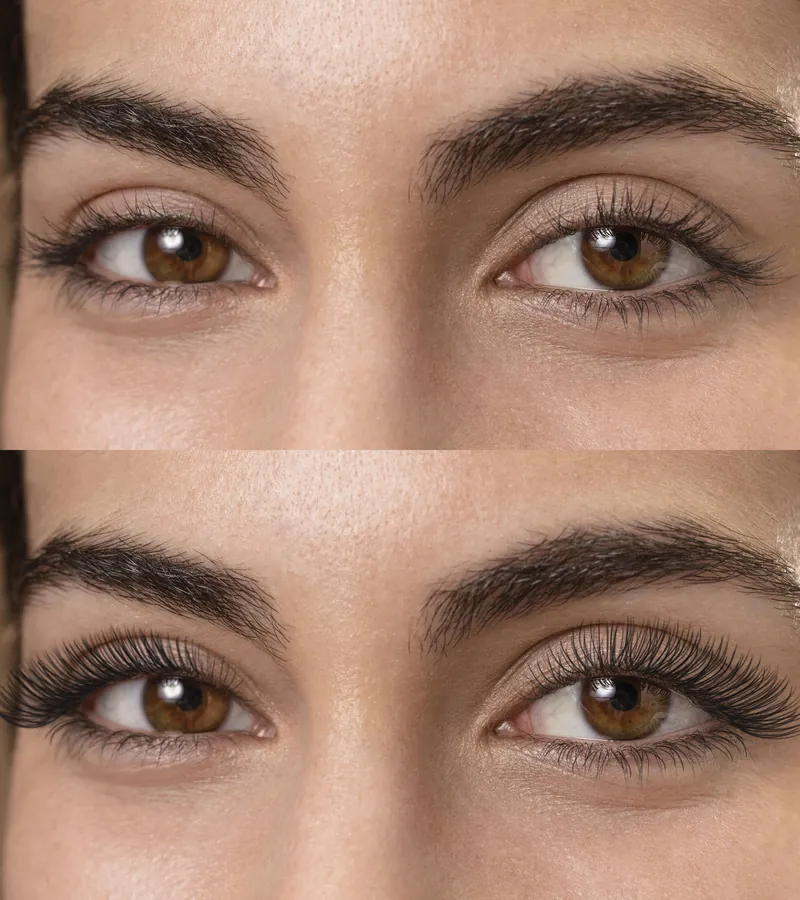
Why nothing works in a week
The lash growth cycle
A serum can only act on lashes in the growth phase — and at any moment that is a minority of your lash line. This is the timing that decides when you see a result, and why stopping returns you to baseline.
of lashes are growing
At any one time the rest are resting or shedding, which is why a serum improves your lash line gradually rather than all at once.
weeks to see it
A lash has to be replaced before the difference is visible. Photographs at week four almost always look like week zero.
weeks to lose it
Stop, and one full cycle returns your lashes to their natural length. No serum here produces a permanent change.
Five seconds, one label
How to check a serum in the shop
Ignore the front of the box entirely. Turn it over and read the INCI list from the top — ingredients are listed in descending order of quantity, so position tells you as much as presence.
-
Search for “prost”
Cloprostenate, prostenolamide, noralfaprostal. If any appear, you are holding a prostaglandin serum whatever the marketing says.
-
Find the peptide
Any “-peptide-” ingredient sitting in the first half of the list is doing real work. Buried at the very end, it is decoration.
-
Check for fragrance and alcohol
Parfum and alcohol denat. near the top are the usual cause of stinging on a product that is otherwise gentle.
-
Look at the volume
2 ml against 5 ml changes the price per month by a factor of two. The tube, not the bottle price, is the real cost.
This page is information, not medical advice. If you have an eye condition, are under an ophthalmologist's care, or are pregnant or breastfeeding, speak to a professional before starting any lash serum. Stop using a product and seek advice if you develop persistent redness, pain or changes in vision.